
ERP Quote Comparison Checklist for UK SMEs: What to Check Before Signing
Navitrends UK · 19 November 2026 · Updated 20/11/2026
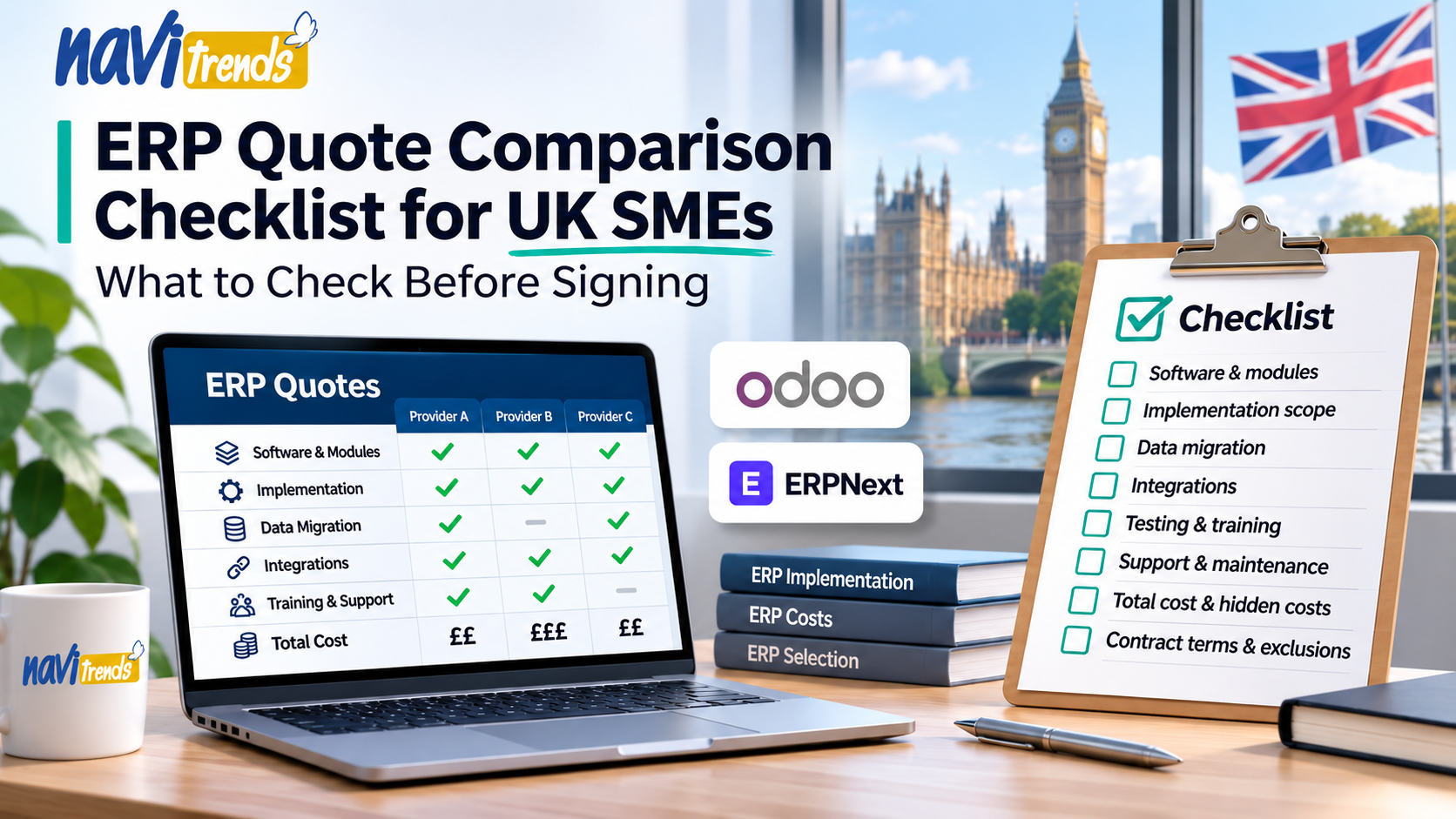
Choosing an Enterprise Resource Planning (ERP) system is a significant decision for a growing business. But receiving several ERP quotations does not necessarily make the decision easier.
Two proposals may appear to offer similar software while including very different levels of configuration, data migration, integration, training and ongoing support.
An ERP quote comparison checklist helps UK businesses evaluate what each proposal actually includes, what remains excluded and how the total cost may change after implementation begins.
The lowest initial quotation is not always the most suitable option. Equally, a higher price does not automatically mean a better implementation.
Quick answer: Before accepting an ERP quote, compare the software edition, required modules, implementation deliverables, data migration, integrations, testing, training, support, recurring costs and contractual assumptions. Ask providers to explain any exclusions before making a decision.
This guide provides a practical checklist for UK SMEs comparing ERP software and implementation proposals.
What Should an ERP Software Quote Include?
An ERP quotation should describe more than the software subscription or licence price.
It should explain what the business will receive, which implementation activities are included and what responsibilities remain with the customer.
A useful ERP proposal should address the following areas.
1. ERP Platform, Edition and Modules
Confirm the exact software platform, edition and applications included in the quotation.
For example, a business may need accounting, purchasing, inventory, sales, CRM or manufacturing functionality.
The quotation should clarify:
Which modules are included.
How many users are covered.
Whether different user roles require different licences.
Which features depend on additional applications or subscriptions.
Whether important requirements need custom development.
Businesses should evaluate the functionality offered by the proposed edition rather than assuming that every advertised capability is included.
2. Implementation and Configuration
ERP implementation involves adapting the selected platform to the organisation's processes and operational requirements.
The proposal should explain which activities are included, such as:
Business process discovery and requirements analysis.
ERP configuration.
User roles and permissions.
Approval workflows.
Reporting requirements.
Customisation and development.
Project management and documentation.
A statement such as "ERP implementation included" is not sufficiently detailed without an agreed scope of work.
For a closer explanation of these activities, explore our ERP Implementation Guide for UK Businesses.
3. Data Migration
Most ERP projects require information to move from spreadsheets, accounting applications, legacy databases or existing business systems.
However, data migration can represent very different amounts of work depending on the organisation.
Before accepting a quotation, establish:
Which datasets will be migrated.
Whether historical transactions are included.
Who will clean and prepare existing records.
How data mapping will be handled.
Whether test migrations are included.
Who will validate financial and operational information.
A quotation that excludes data cleansing or validation may leave significant work with the business.
Read our ERP Data Migration Guide for additional preparation steps.
4. Integration With Existing Applications
A business may already use CRM software, e-commerce platforms, accounting tools, warehouse systems or industry-specific applications.
These systems may need to exchange information with the new ERP.
An ERP quote should identify which integrations are included and whether they rely on standard connectors, APIs or custom development.
It should also clarify who will maintain the integrations after implementation.
Before signing, ask the provider to explain what happens if an existing application changes its API, data structure or authentication requirements.
5. Testing, Training and Go-Live
An ERP is not ready for business use simply because its modules have been configured.
Employees must be able to complete the workflows required by their roles, and the organisation must have confidence in the accuracy of its operational information.
A detailed proposal should explain whether it includes:
Functional and integration testing.
User acceptance testing.
Data migration validation.
Employee training.
Go-live preparation.
Initial troubleshooting and support.
The business should also understand who decides whether the system is ready to go live.
6. Ongoing Maintenance and Support
Some ERP quotations focus on implementation while providing limited information about what happens afterwards.
Businesses should clarify the expected costs and arrangements for:
Technical support.
Hosting and infrastructure.
Software updates.
Security maintenance.
Integration monitoring.
Additional user training.
Future customisation.
Changes to business processes.
The expected scope of ongoing support should be documented before the implementation agreement is signed.
ERP Quote Comparison Checklist for UK SMEs
Use this table when evaluating two or more ERP proposals.
Area | What to Compare |
|---|---|
Software | ERP edition, modules, user licences and subscriptions |
Business requirements | Essential workflows included or excluded |
Implementation | Discovery, configuration, development and deliverables |
Data migration | Datasets, cleansing, mapping, testing and validation |
Integration | Existing applications, connectors, APIs and maintenance |
Testing | Business scenarios, acceptance criteria and responsibilities |
Training | Number of users, training format and documentation |
Hosting | Deployment model, infrastructure and responsibilities |
Support | Response arrangements, updates and maintenance |
Commercial terms | Payment milestones, exclusions, changes and recurring costs |
Practical recommendation: Ask every provider to respond to the same requirements document. This makes the proposals easier to compare and helps reveal differences that may be hidden behind similar headline prices.
What Costs Are Commonly Overlooked in ERP Quotations?
ERP pricing can extend beyond the initial software and implementation charges.
The following areas deserve particular attention.
Internal Staff Time
Employees may need to participate in workshops, data preparation, testing, training and project decisions.
These activities require time that should be considered when planning the implementation.
Additional Customisation
New requirements may emerge during configuration or testing.
Businesses should understand how change requests are assessed, approved and priced.
Integration Maintenance
Connecting existing systems to an ERP may create ongoing maintenance responsibilities.
Changes to external applications, APIs or business processes can require future technical work.
Data Preparation
Poor-quality customer, supplier, inventory or financial information may require additional cleaning before migration can succeed.
Recurring Costs
Subscriptions, hosting, storage, support and third-party integrations may create recurring expenses.
Businesses should request a clear explanation of which costs are one-off and which will continue after go-live.
For a broader discussion of these factors, read our ERP Pricing Guide for UK Businesses.
How to Prepare an ERP Request for Quotation
A useful ERP quotation starts with clear information about the business.
Before contacting providers, prepare a short requirements document.
Describe Your Organisation
Include the main business activities, approximate number of users, operational locations and departments involved.
Explain Your Existing Systems
Identify the accounting, CRM, inventory, e-commerce or other applications currently used.
Explain which systems need to remain operational.
Define Your Main Problems
Focus on genuine operational challenges, such as duplicated data entry, disconnected departments, inconsistent inventory information or reporting delays.
Identify Essential Requirements
Separate critical functionality from improvements that could be introduced later.
Clarify Implementation Expectations
Explain any known requirements relating to data migration, integration, training, deployment and ongoing support.
Request a Consistent Proposal Structure
Ask providers to present software costs, implementation work, integrations, migration, training and support separately.
This helps reduce ambiguity when comparing quotations.
UK-Specific Considerations When Comparing ERP Quotes
ERP proposals for UK businesses should also address relevant accounting, security and data protection requirements.
VAT and Making Tax Digital
Where applicable, businesses should verify that their proposed accounting environment supports their relevant VAT reporting obligations.
The presence of an accounting module does not automatically guarantee that a particular ERP edition or integration meets every requirement.
HMRC provides an official resource for checking software compatible with Making Tax Digital for VAT.
Data Protection and Supplier Responsibilities
ERP systems may contain customer, employee, supplier or other personal information.
Where a service provider processes personal data on behalf of a business, the applicable UK GDPR responsibilities and contractual arrangements should be assessed.
The Information Commissioner's Office (ICO) provides guidance on contracts and responsibilities between controllers and processors.
Businesses should verify their own requirements rather than assuming that all ERP contracts provide identical protections.
Hosting and Security
When comparing cloud-based or externally hosted ERP proposals, review data access, backups, incident response responsibilities, service continuity and supplier security arrangements.
The UK's National Cyber Security Centre provides guidance on evaluating cloud providers.
These considerations should form part of the provider evaluation, not be treated solely as questions for the technical team after purchase.
Comparing Odoo and ERPNext Quotations
Odoo and ERPNext are two configurable ERP platforms that UK businesses may evaluate when considering integrated operational systems.
However, comparing proposals based only on their software licensing models can be misleading.
Odoo Quotations
An Odoo proposal should identify the relevant edition, applications, user requirements, hosting arrangements, configuration and customisation scope.
Businesses should also consider integrations, migration and ongoing maintenance.
Explore NaviTrends' Odoo Implementation & Customisation Services.
ERPNext Quotations
ERPNext is an open-source ERP platform, but this does not make its business implementation free of cost.
Hosting, implementation, configuration, custom development, integrations, technical maintenance and support may all form part of a commercial proposal.
Explore NaviTrends' ERPNext Implementation & Customisation Services.
For both platforms, a meaningful comparison should focus on the complete business solution rather than the software licence alone.
Warning Signs to Look for Before Signing an ERP Contract
Some quotations may leave important assumptions unclear.
Before proceeding, ask for clarification when:
Required business processes are not documented.
The quotation does not identify excluded functionality.
Integration requirements are described only in general terms.
Data migration responsibilities are unclear.
Testing and user acceptance criteria are missing.
Training is not defined.
Ongoing support costs are not explained.
Custom development is proposed without assessing standard functionality.
Future changes are not covered by an agreed approval process.
These issues do not necessarily mean the provider is unsuitable. They indicate areas that should be clarified before the project begins.
Frequently Asked Questions About ERP Quotations
What Should an ERP Quote Include?
An ERP quote should clearly identify the software, licences, implementation scope, data migration, integrations, testing, training, ongoing support, costs and responsibilities. Any significant exclusions should also be documented.
How Do You Compare Two ERP Software Quotes?
Compare the proposals against the same business requirements and implementation scope. Review the included deliverables, assumptions, exclusions, recurring costs and responsibilities rather than choosing based on the lowest initial price.
Is ERP Implementation Included in the Software Price?
Not necessarily. Software subscriptions and implementation services are often priced separately. Businesses should confirm the commercial arrangement for the specific platform and provider.
Should Data Migration Be Included in an ERP Quote?
Where migration is required, its scope and responsibilities should be explicitly addressed. The quotation should explain which records will be migrated, who will prepare them and how accuracy will be validated.
Can an ERP Quote Change After the Project Starts?
Project costs can change when requirements or agreed scope change. Businesses should understand the contractual process for assessing and approving additional work before implementation begins.
Is the Cheapest ERP Quote the Best Choice?
Not necessarily. A lower initial quotation may exclude important work, while a higher quotation may include services that the business does not require. The best comparison is based on operational fit, scope, responsibilities, costs and long-term suitability.
Discuss Your ERP Requirements With NaviTrends
Choosing an ERP solution should start with understanding your organisation's operational needs, not simply comparing software prices.
At NaviTrends, we work with businesses to analyse processes, assess ERP implementation requirements, connect existing applications and identify opportunities for practical workflow improvement.
Whether you are evaluating Odoo, ERPNext or looking to improve your existing business systems, a clear understanding of scope is essential before making technical decisions.
Book a 30-Minute Diagnostic with NaviTrends
Discuss one operational challenge, the systems you currently use and the outcomes you want to achieve. This can help clarify the next steps before committing to a larger ERP project.