
ERP Implementation: A Practical Guide for UK Businesses
Navitrends UK · 5 October 2026 · Updated 08/10/2026
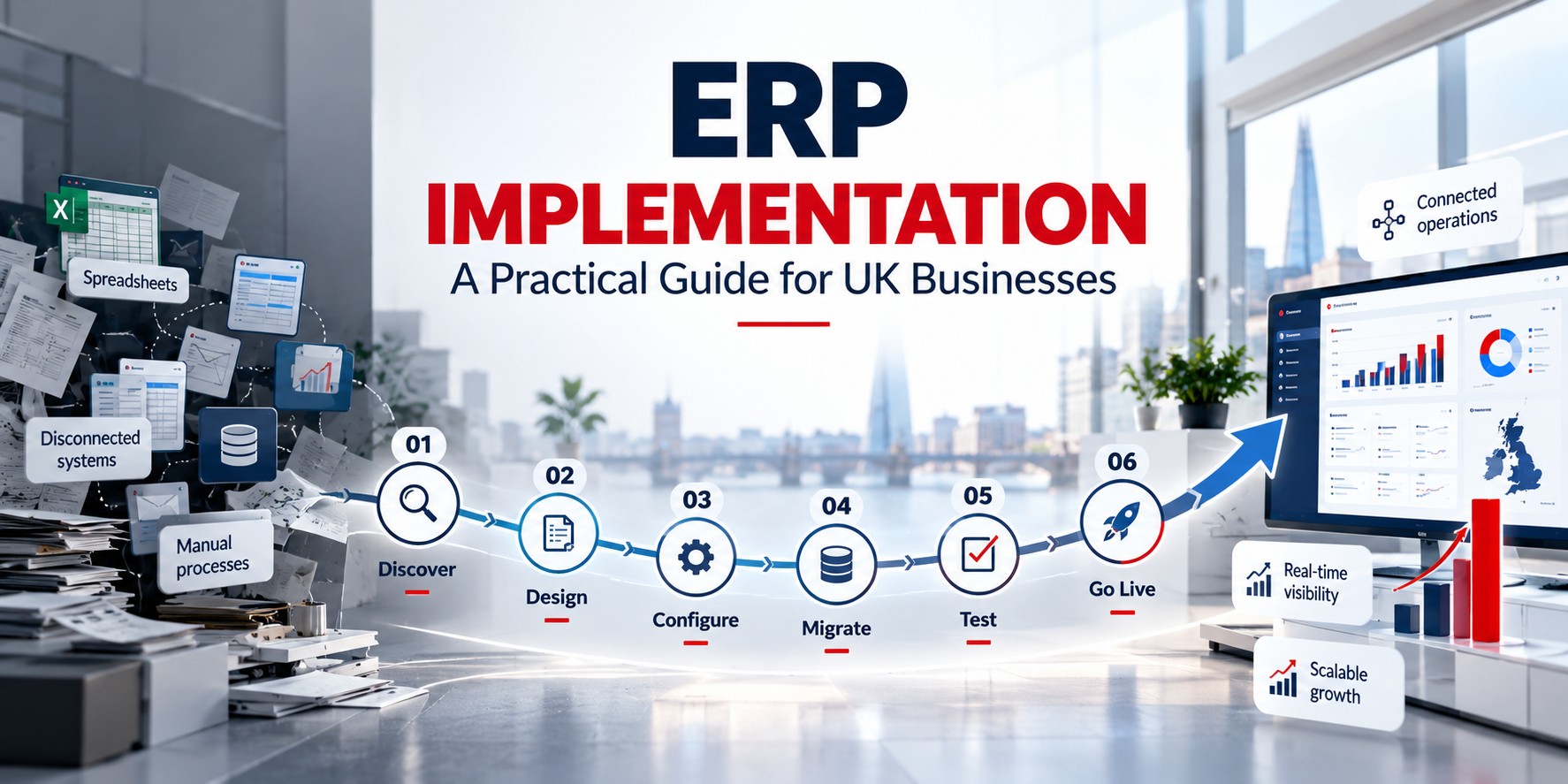
Implementing an ERP system is not simply a software installation. It is a business transformation project that can affect processes, data, systems and the way teams work across an organisation.
For UK businesses, a successful ERP implementation starts long before configuration begins. The organisation needs to understand its current processes, identify operational problems, define requirements and determine how the ERP should interact with existing systems.
Whether a business is implementing its first ERP, replacing an existing platform or modernising a fragmented technology environment, a structured implementation approach can reduce unnecessary complexity and help the system support real operational needs.
This guide explains the main stages of ERP implementation, the decisions businesses should consider and some of the common mistakes to avoid.
What Is ERP Implementation?
ERP implementation is the process of introducing an Enterprise Resource Planning system into an organisation and adapting it to support its business operations.
The process can include requirements analysis, process design, software configuration, customisation, data migration, systems integration, testing, user training and go-live preparation.
The objective is not simply to make the ERP technically operational. The system should support the organisation's processes while providing reliable information across relevant business functions.
The scope of an implementation can vary considerably depending on the size of the organisation, the complexity of its operations, its existing technology environment and the ERP platform selected.
When Does a Business Need a New ERP?
Businesses often begin considering ERP implementation when existing processes and systems make operations increasingly difficult to manage.
Common signs can include teams relying heavily on spreadsheets, information being entered manually into multiple systems, limited visibility across departments, disconnected applications and processes that have become difficult to scale.
An organisation may also already have an ERP but find that the existing environment no longer reflects how the business operates.
Before selecting new software, businesses should identify the underlying operational problems. Replacing technology without understanding those problems can simply reproduce them in a different system.
The ERP Implementation Process
Although every ERP project is different, a structured implementation normally moves through several important stages.
Understanding these stages helps businesses prepare the right people, data and systems before go-live.
1. Discovery and Requirements
The first stage is understanding how the organisation currently operates.
This includes identifying key processes, users, systems, data sources, manual activities and operational problems.
Requirements should be based on genuine business needs rather than simply creating a long list of requested software features.
2. Process Design
Once the current environment is understood, the future processes can be designed.
This stage determines how activities should work within the ERP, which processes can use standard functionality and where changes may be required.
It is also an opportunity to simplify inefficient processes rather than reproducing every existing workflow inside the new system.
3. Configuration and Customisation
The ERP can then be configured around the agreed processes and requirements.
Standard functionality should generally be used where it adequately supports the business requirement.
Custom development can be valuable when a genuine operational need cannot be addressed appropriately through configuration, but unnecessary customisation can increase long-term complexity.
4. Data Migration
ERP implementation often requires information to be transferred from spreadsheets, legacy systems or other business applications.
Before migration, data should be reviewed, cleaned and mapped to the new environment.
Poor-quality or duplicated data can create problems even when the ERP itself has been implemented correctly, making data preparation an important part of the project.
5. Systems Integration
An ERP does not always need to replace every application already used by the business.
Specialised systems may continue to provide value and can sometimes be integrated with the ERP through APIs or other integration methods.
Integration planning should identify which information needs to move between systems, how frequently it should move and which system should remain responsible for each type of data.
6. Testing
Testing should confirm that processes, configurations, custom developments, integrations and migrated data work as expected.
Realistic business scenarios are particularly important.
Testing only individual features without validating complete workflows can leave problems undiscovered until users begin working with the system.
7. Training and Go-Live
Users need to understand how the new ERP supports the processes relevant to their roles.
Training should therefore focus on real operational workflows rather than simply demonstrating software screens.
Before go-live, organisations should also establish responsibilities, support arrangements and a plan for handling issues during the transition.
Common ERP Implementation Mistakes
ERP projects can become unnecessarily complex when technology decisions are made without enough attention to business processes.
One common mistake is attempting to reproduce every existing workflow exactly as it currently operates, including inefficient manual processes.
Another is excessive customisation. Developing functionality simply because it is possible can make the ERP harder to maintain and evolve.
Data quality can also be underestimated. Migrating incomplete, duplicated or inconsistent information into a new system transfers existing problems rather than solving them.
Finally, businesses should not overlook users. Even a technically successful ERP implementation can struggle if the people who work with the system do not understand the new processes.
How Long Does ERP Implementation Take?
There is no universal ERP implementation timeline.
The duration depends on factors such as the number of business processes involved, the quality and volume of existing data, required integrations, custom development, number of users and organisational readiness.
A relatively focused implementation can be very different from a multi-department project involving complex manufacturing processes, multiple systems and significant data migration.
For this reason, businesses should be cautious of implementation timelines provided before the project scope and requirements have been properly understood.
ERP Implementation for Manufacturing Businesses
Manufacturing businesses can have particularly demanding ERP requirements because information needs to move across purchasing, inventory, production, sales and finance.
An ERP implementation may need to consider materials, stock movements, production processes, purchasing requirements and operational reporting alongside standard commercial processes.
The implementation should therefore reflect how the organisation actually produces, purchases, stores and delivers its products rather than treating manufacturing as an isolated software module.
Integrations may also be required where specialised production, warehouse, e-commerce or other operational systems remain in use.
Choosing the Right ERP Implementation Approach
Selecting an ERP platform is important, but implementation approach matters just as much.
Businesses should first understand their operational requirements and then determine which platform and implementation model best support them.
Open-source ERP platforms such as Odoo and ERPNext can provide flexibility around configuration, development and integration, but that flexibility should be used carefully.
The objective should not be to customise everything. It should be to create an ERP environment that uses suitable standard functionality while adapting or integrating the platform where genuine business requirements justify it.
Frequently Asked Questions About ERP Implementation
What are the main stages of ERP implementation?
Typical stages include discovery and requirements analysis, process design, configuration, data migration, systems integration, testing, user training and go-live. The exact structure depends on the organisation and project scope.
Does ERP implementation include data migration?
Data migration is often an important part of ERP implementation when information needs to be transferred from existing systems, spreadsheets or databases. The data should normally be reviewed and cleaned before migration.
Can an ERP integrate with existing software?
Yes. An ERP can often be connected with existing applications through APIs or other integration methods. This can allow businesses to retain specialised systems rather than replacing every application.
Should an ERP be customised?
Customisation can be appropriate when standard functionality cannot adequately support a genuine business requirement. However, unnecessary customisation can increase implementation and maintenance complexity.
What happens after ERP go-live?
Go-live is not necessarily the end of an ERP project. Businesses may need ongoing support, process improvements, additional integrations, automation and further development as operational requirements evolve.
Planning an ERP Implementation?
A successful ERP implementation should connect technology decisions with the way the organisation actually operates.
NaviTrends supports businesses with ERP implementation, customisation, data migration, systems integration, workflow automation, user training and ongoing improvement.
Businesses evaluating open-source ERP can also explore our Odoo Implementation & Customisation and ERPNext Implementation & Customisation services to understand how these platforms can be adapted around operational requirements.