
7 Signs Your Business Has Outgrown Spreadsheets and Needs Process Automation
Navitrends UK · 29 October 2026 · Updated 29/10/2026
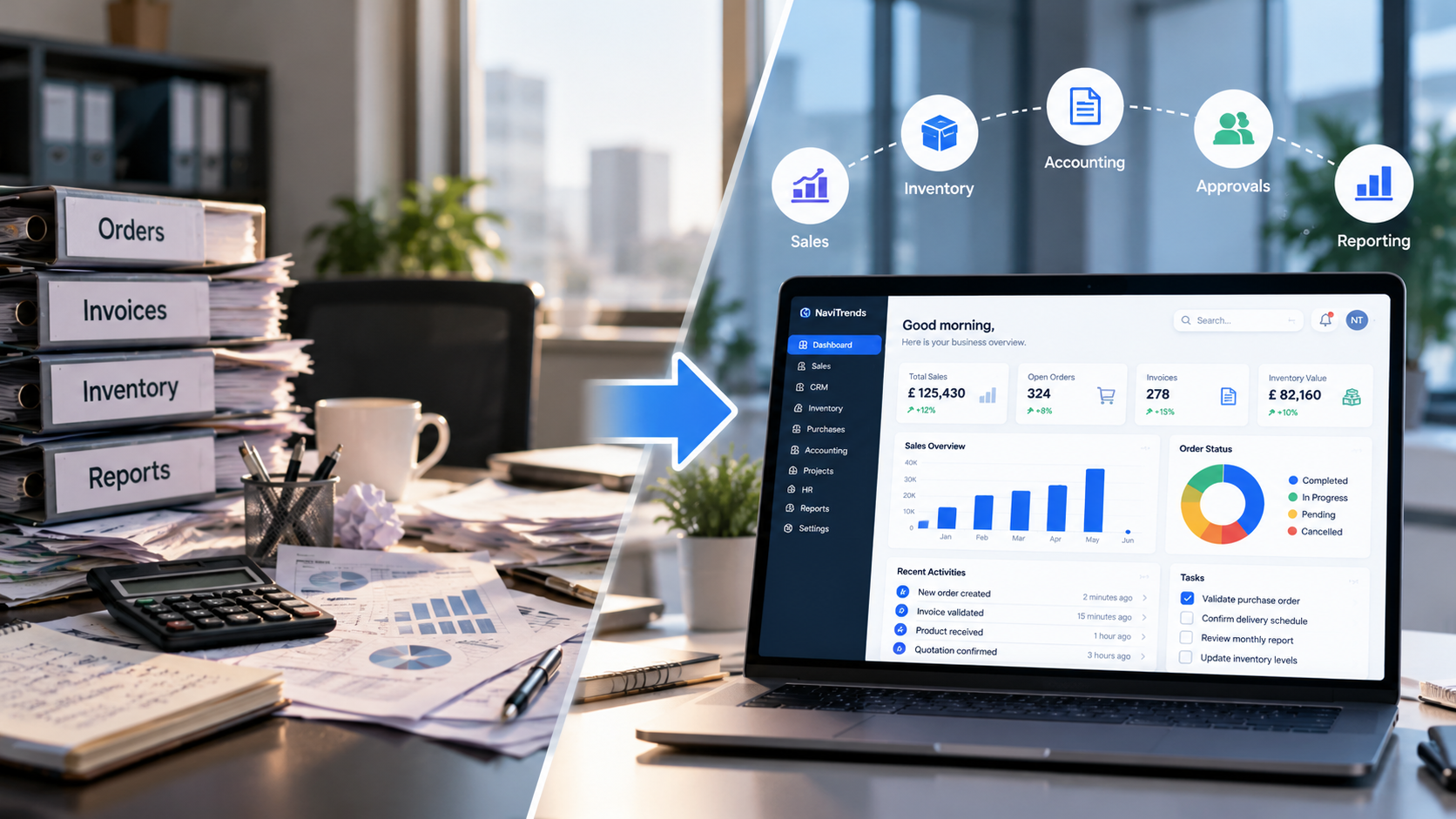
7 Signs Your Business Has Outgrown Spreadsheets and Needs Process Automation
Spreadsheets are often the starting point for managing business operations. They are familiar, flexible and relatively easy to use.
But as a company grows, the same spreadsheets that once made work easier can become a source of delays, duplicated information and operational inefficiency.
For many UK SMEs, the challenge is not a lack of software. It is that everyday processes rely on disconnected tools, manual updates and information that does not flow easily between teams.
So how can you tell when it is time to move beyond spreadsheets and introduce business process automation?
Here are seven signs worth paying attention to.
1. Your Teams Enter the Same Information Multiple Times
A customer places an order. The sales team updates a spreadsheet, the finance team enters the details into accounting software, and the operations team records the same information elsewhere.
Every additional manual entry takes time and creates another opportunity for mistakes.
What automation can improve: Connecting systems and workflows can reduce repetitive data entry and help teams work with more consistent information.
2. Important Information Is Scattered Across Different Files
Customer details, quotations, invoices, inventory records and project updates may be stored in separate spreadsheets or applications.
Finding the latest information becomes difficult, especially when several people maintain different versions.
What automation can improve: Centralising information and integrating business applications can make operational data easier to access and maintain.
3. Reporting Takes Too Much Time
Does your team spend hours collecting figures from different sources before preparing a management report?
When reporting depends on manually combining spreadsheets, information may already be outdated by the time it reaches decision-makers.
What automation can improve: Connected reporting workflows can reduce manual consolidation and provide more timely visibility into business performance.
4. Approvals Depend on Emails and Manual Follow-Ups
Purchase requests, quotations, expenses and other business decisions often require approval.
When these processes rely entirely on email exchanges, requests can be overlooked, responsibilities become unclear and delays are difficult to track.
What automation can improve: Structured approval workflows can help route requests to the right people, record decisions and improve accountability.
5. Errors Are Becoming More Frequent
Manual processes can introduce duplicate records, incorrect figures, missed updates and inconsistent customer information.
As transaction volumes increase, correcting these errors can consume valuable time.
What automation can improve: Standardised workflows, validation rules and connected systems can reduce avoidable manual errors and improve data consistency.
6. Your Business Cannot Easily Track Operations in Real Time
Managers need visibility into sales activity, order progress, inventory levels, project status and other operational indicators.
If obtaining this information requires asking several employees for updates, decision-making can become slower.
What automation can improve: Integrated business systems and dashboards can provide a clearer view of operational activity and support more informed decisions.
7. Growth Is Making Everyday Work More Complicated
A process that works for five employees may become difficult to manage when a business expands across departments, locations or markets.
More customers, transactions and responsibilities often mean more coordination.
Without structured processes, growth can increase administrative workload instead of improving efficiency.
What automation can improve: Scalable workflows can help businesses manage increasing complexity without relying on the same volume of repetitive manual tasks.
Does Your Business Need Automation or an ERP System?
Not every operational problem requires a complete ERP implementation.
Some businesses may benefit from automating a specific process, such as invoice approvals, customer enquiries or data synchronisation.
Others may need a more integrated solution that connects sales, finance, inventory, purchasing and reporting.
The right approach depends on the underlying problem.
Business challenge | Potential approach |
|---|---|
Repetitive administrative tasks | Workflow automation |
Disconnected business applications | Systems integration |
Fragmented sales and financial processes | ERP implementation |
Limited operational visibility | Reporting and dashboards |
Inconsistent data across departments | Data integration and process standardisation |
The objective should be to improve how the business operates, not to introduce technology for its own sake.
How to Start Automating Business Processes
A successful automation initiative begins with understanding existing operations.
Identify repetitive tasks
Look for activities that consume time, involve repeated data entry or require frequent manual follow-ups.
Map the current workflow
Document how information moves between people, departments and applications. Identify unnecessary steps, delays and duplicated work.
Prioritise high-impact improvements
Start with processes where automation could deliver clear operational benefits and where implementation is manageable.
Connect the right systems
Evaluate whether existing applications can be integrated or whether a more comprehensive business management solution is required.
Measure the results
Track relevant indicators such as processing time, error frequency, manual effort and workflow completion rates.
These measurements help determine whether the changes are delivering meaningful value.
How NaviTrends Helps Businesses Simplify Operations
At NaviTrends, we help organisations improve business operations through ERP solutions, business process automation and systems integration.
Our approach starts with understanding the operational challenge before identifying the most appropriate solution.
Whether a business needs to connect existing applications, automate repetitive workflows or introduce an integrated ERP environment, the goal remains the same: simpler processes, better information flow and more connected operations.
Final Thoughts
Spreadsheets are useful tools, and they do not need to disappear from every business.
However, when critical operations depend on disconnected files, repetitive manual updates and unclear workflows, it may be time to reconsider how information is managed.
Business process automation can help organisations reduce unnecessary work, improve consistency and create a stronger foundation for growth.
Is your business spending too much time on manual processes?
Discover how NaviTrends can help you identify opportunities for automation and build more efficient operations.