
Open ERP and Odoo: How Open-Source ERP Works
Navitrends UK · 2 October 2026 · Updated 02/10/2026
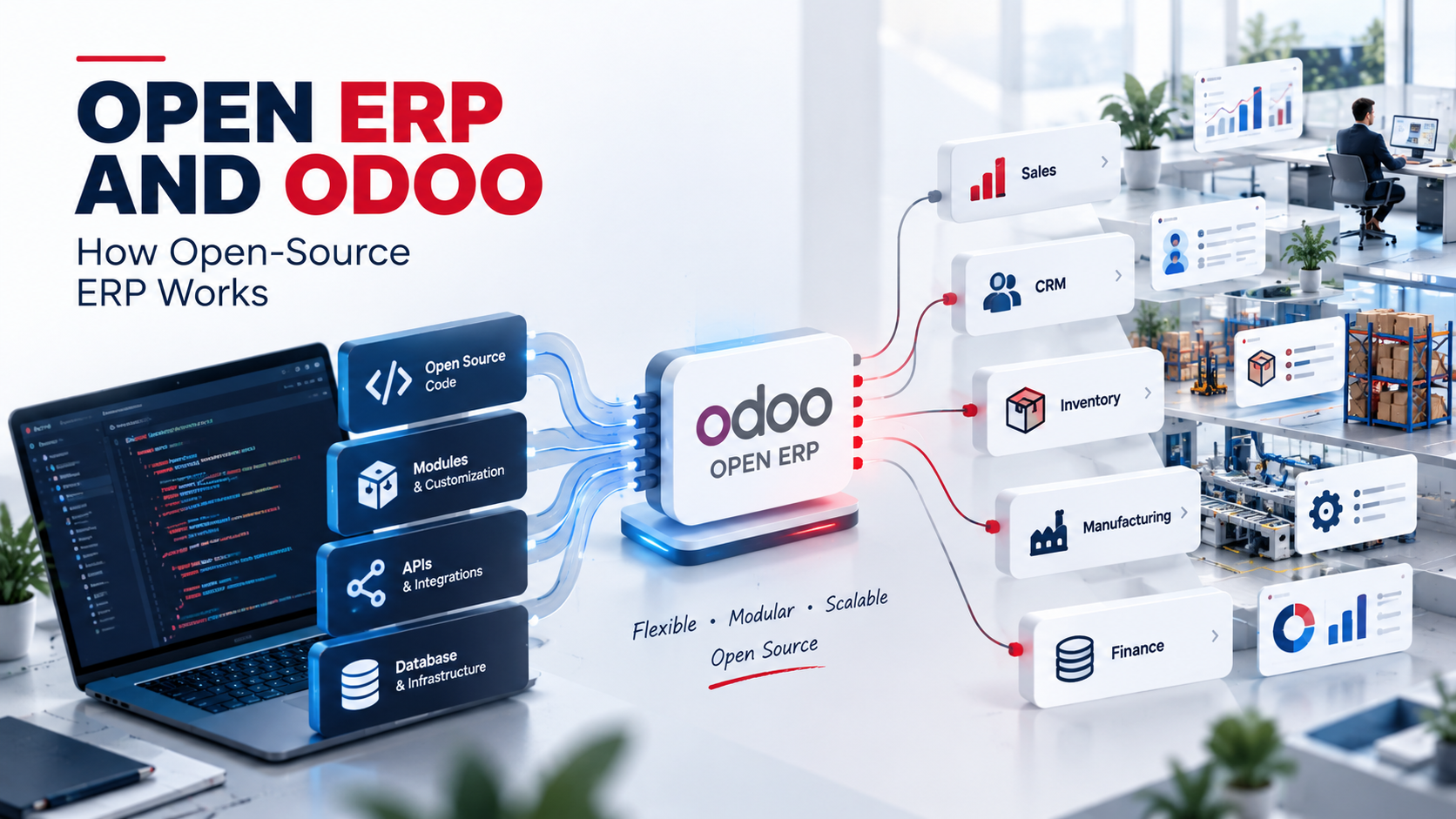
Enterprise Resource Planning systems are designed to connect core business processes such as finance, sales, purchasing, inventory and operations within a more structured environment.
But businesses evaluating ERP software increasingly face another question: should the platform be proprietary, or should they consider an open-source ERP?
The term Open ERP is often associated with flexible, open-source business software and has a particularly important connection with Odoo, which evolved from the OpenERP project into the business platform known today.
For UK businesses evaluating Odoo or other ERP options, understanding what open-source ERP actually means is more useful than simply comparing lists of software features.
This guide explains how open-source ERP works, where Odoo fits into the landscape, and what businesses should consider before implementing or customising an ERP environment.
What Is Open ERP?
Open ERP generally refers to Enterprise Resource Planning software built around an open-source model, where the underlying source code is available for use, modification and extension according to the software's licence.
Like other ERP systems, an open-source ERP can bring different business processes into one environment, including sales, purchasing, inventory, finance, manufacturing and other operational activities.
The difference is not simply that the software is open source. For businesses, one of the main considerations is the ability to adapt the ERP around specific processes, connect it with other systems and develop additional functionality when standard features are not sufficient.
This flexibility does not remove the need for careful implementation. Configuration, custom development, integrations, data migration and ongoing maintenance still need to be planned around the organisation's actual requirements.
From OpenERP to Odoo
Odoo has its roots in an open-source ERP project that was previously known as OpenERP. The platform was later renamed Odoo as its scope expanded beyond traditional ERP functionality.
Today, Odoo provides a broad range of business applications covering areas such as CRM, sales, purchasing, inventory, manufacturing, accounting, projects and other operational processes.
This history explains why searches such as “OpenERP Odoo” or “Open ERP Odoo” still appear today. They generally refer to the relationship between the former OpenERP name and the Odoo platform.
For businesses, however, the more important question is not the name change. It is how an open-source platform such as Odoo can be configured, customised and integrated around the organisation's actual processes.
How Does Open-Source ERP Work?
Open-source ERP combines the core principles of Enterprise Resource Planning with a software model that allows the underlying code to be accessed and extended under its applicable licence.
In practice, a business can start with standard ERP functionality and then configure the system around its processes. Where standard features are not sufficient, additional workflows, integrations or custom functionality can be developed.
This can be particularly useful when an ERP needs to communicate with existing business systems rather than replace them all. For example, an organisation may keep specialised e-commerce, logistics or operational software while connecting relevant information to the ERP.
The value therefore comes not only from the ERP software itself, but from how effectively the platform is configured, integrated and maintained around the business.
Open-Source ERP vs Proprietary ERP
Open-source and proprietary ERP systems can both support complex business operations, but they differ in areas such as software access, customisation, licensing and the way organisations manage their ERP environment.
With proprietary ERP, the software vendor controls the underlying platform and determines how the product can be modified or extended. Open-source ERP provides greater access to the software itself, which can create more flexibility for organisations with specific operational or integration requirements.
However, greater flexibility does not automatically make open-source ERP the right choice for every business. Customisation can also introduce complexity if it is not carefully designed and maintained.
The decision should therefore be based on business processes, required functionality, existing systems, integration needs, internal capabilities and the long-term approach to maintaining the ERP environment.
Why Do Businesses Consider Open-Source ERP?
Businesses may consider open-source ERP when they need greater flexibility around how their operational systems are configured, extended and connected.
For some organisations, the priority is adapting workflows around specific processes. For others, it may be connecting the ERP with existing applications, reducing manual information transfer or developing functionality that is not available in the standard configuration.
Open-source ERP can also give organisations more options in how their ERP environment evolves over time. However, flexibility needs to be managed carefully. Excessive customisation can make an ERP more complex to maintain and upgrade.
The objective should therefore be to customise only where it creates genuine operational value, while using standard functionality wherever it already meets the business requirement.
Where Does Odoo Fit In?
Odoo is an ERP platform built around a modular approach, allowing businesses to use applications for areas such as sales, CRM, purchasing, inventory, manufacturing, finance and project operations within a connected environment.
For businesses evaluating open-source ERP, Odoo is relevant because the platform can support both standard business processes and more specific requirements through configuration, customisation and development.
An Odoo ERP environment can also be integrated with existing business applications through APIs and connected workflows. This means businesses do not necessarily need to replace every specialised system already in use.
The important consideration is therefore not simply whether Odoo offers a particular module. Businesses should evaluate how the platform fits their processes, existing systems, data and future operational requirements.
Odoo Configuration vs Customisation
One of the most important decisions in an Odoo project is determining what should use standard functionality and what genuinely needs to be customised.
Configuration involves adapting available Odoo features, settings and workflows to the organisation's requirements without unnecessarily changing the underlying system.
Customisation becomes relevant when standard functionality does not adequately support a specific business process. This may involve adapting workflows, developing additional functionality or extending how Odoo interacts with other systems.
More customisation is not necessarily better. Unnecessary development can increase complexity and make the environment harder to maintain over time. A strong implementation should therefore start with the business requirement and use standard functionality wherever it provides an appropriate solution.
Can Odoo Integrate With Existing Business Systems?
Yes. Odoo can form part of a wider technology environment rather than operating as an isolated system.
Depending on the organisation's requirements, integrations can connect Odoo with e-commerce platforms, CRM tools, logistics systems, operational applications and other business software.
APIs and connected workflows can allow relevant information to move between systems, reducing the need for employees to repeatedly transfer data manually.
The objective is not necessarily to move every business process into Odoo. In some cases, the better approach is to keep specialised systems that already provide value and connect them with Odoo where information needs to flow between processes.
Integration requirements should therefore be identified during the implementation or improvement process, with each connection designed around a clear operational need.
Is Open-Source ERP Right for Your Business?
Open-source ERP can be worth considering when a business needs an operational system that can evolve around its processes, integrations and future requirements.
It may be particularly relevant when teams rely on disconnected applications, spreadsheets or manual workflows, or when an existing ERP no longer reflects how the organisation operates.
However, choosing an ERP should not be based on the open-source model alone. Businesses should consider their processes, required functionality, existing systems, data migration needs, integration requirements and the resources needed to maintain the environment over time.
The right ERP is ultimately the one that supports the organisation's operational requirements without introducing unnecessary complexity.
Implementing Odoo Around Your Business Processes
A successful Odoo implementation should begin with understanding how the business actually operates rather than simply enabling a collection of modules.
Before configuration or development begins, organisations should identify their key processes, existing systems, data requirements, manual activities and integration needs. This helps determine what Odoo can handle through standard functionality and where customisation, development or integration may create additional value.
Implementation should also consider data migration, testing, user preparation and the transition to the new environment. Once Odoo is in use, the platform can continue to evolve as processes and operational requirements change.
NaviTrends helps businesses implement, customise and integrate Odoo around their operational requirements, including data migration, workflow automation and connections with existing business systems.
Frequently Asked Questions About Open ERP and Odoo
Is OpenERP the same as Odoo?
OpenERP was the former name of the platform that later became Odoo. The name changed as the platform expanded beyond traditional ERP functionality into a broader suite of business applications.
Is Odoo an open-source ERP?
Odoo has an open-source Community edition alongside its Enterprise offering. Businesses should consider the functionality, customisation, integration and support requirements of their specific environment when evaluating the appropriate approach.
Can Odoo be customised?
Yes. Odoo can be configured and extended around specific business requirements. Custom development should be used where it provides genuine operational value rather than replacing suitable standard functionality unnecessarily.
Can Odoo integrate with existing software?
Yes. Odoo can be connected with other business applications through APIs and integrations, allowing organisations to retain specialised systems where appropriate while connecting relevant processes and data.
Considering Odoo for Your Business?
Choosing Odoo is only one part of building an effective ERP environment. The platform needs to be configured around the organisation's processes, connected with the right systems and adapted carefully where standard functionality does not meet the requirement.
NaviTrends supports businesses with Odoo implementation, customisation, integration, data migration and workflow automation.
Explore our Odoo Implementation & Customisation services to learn how NaviTrends can help build an Odoo environment around your operational requirements.